
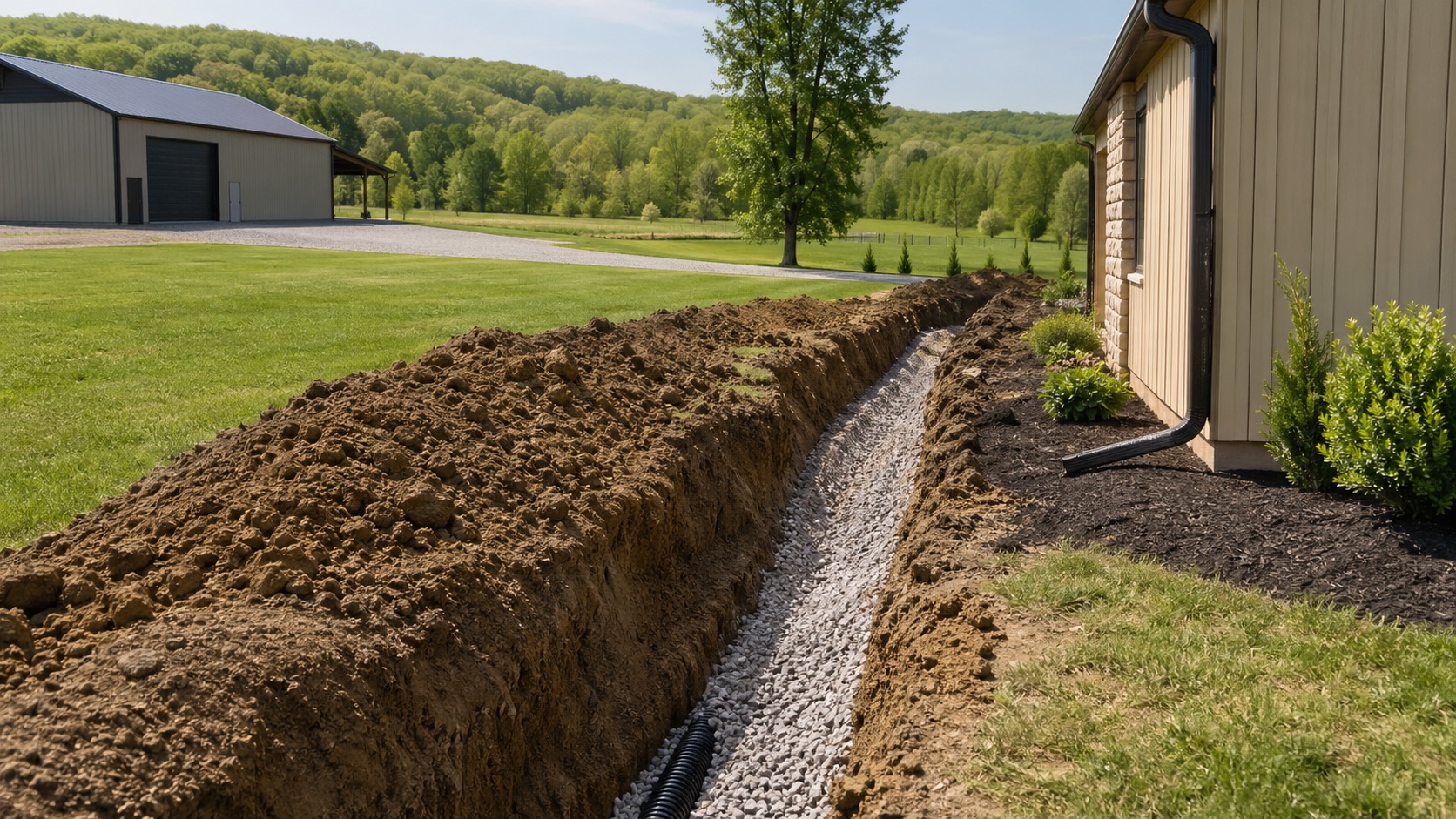
If part of your property stays soft, soggy, or muddy after every rain, the problem usually is not just inconvenience — it is water moving badly across the site. In Northeast Ohio, that often shows up as wet side yards, standing water near foundations, muddy low spots, or runoff cutting across driveways and lawns. In many of those cases, a French drain is one of the most practical fixes.
The key is knowing when a French drain is the right answer and when the better fix is grading, culvert work, or broader site drainage correction. If you are looking at a recurring water problem, our French drains and yard drainage service and site grading and drainage correction service are built around exactly this kind of work.
What a French Drain Actually Does
A French drain is designed to collect water underground and move it away from the trouble area. That usually means excavating a trench, installing drainage stone and perforated pipe, and giving the water a place to discharge where it will not create a new problem.
This is different from just reshaping the top of the yard. A French drain addresses water that keeps gathering below the surface or along foundation edges, not just puddles sitting on top of the lawn for a few hours.
Common Signs You May Need a French Drain
- The same area stays wet for days after normal rain
- Your side yard turns muddy even when the rest of the property dries out
- Water keeps collecting along the foundation or near a basement wall
- A down-slope section of yard feels soft and spongy much of the year
- Runoff from neighboring grade keeps feeding a low area on your lot
- You have already tried simple surface fixes and the water problem keeps coming back
When a French Drain Is the Right Fix
French drains are usually the best fit when the property needs water collected and redirected — not just a little surface reshaping. That can include foundation edges, side yards trapped between structures and property lines, low areas with poor natural drainage, or places where runoff keeps saturating the soil before it can move away.
They also make sense as part of larger drainage correction. A site may need a French drain plus some grading work, or a French drain tied into a better outlet path. Good drainage work is usually about combining the right pieces, not forcing every problem into the same solution.
When the Better Fix Is Something Else
Not every wet property needs a French drain. Sometimes the real issue is poor slope. Sometimes it is a driveway crossing that needs a culvert. Sometimes it is a broad grading issue where the site simply is not sending water where it should go. In those cases, a culvert installation or grading and drainage correction job may be the smarter answer.
That is why on-site evaluation matters. The goal is not to sell pipe. The goal is to stop the water problem from repeating.
What French Drain Installation Usually Involves
- Walk the property to understand where the water is starting and where it can discharge
- Excavate the trench with the right depth and slope for the site
- Install stone and perforated drain pipe
- Tie the system into a safe discharge point
- Restore the disturbed area as cleanly as possible and make sure the site still works visually and practically
French Drains and Foundations
One of the biggest reasons people ask about French drains is foundation water. If runoff keeps collecting along the house, garage, or outbuilding, the soil around that structure stays saturated longer than it should. Over time, that can contribute to moisture problems, muddy access, and more aggressive waterproofing needs.
When the issue is deeper or tied directly to exterior foundation work, that can overlap with basement waterproofing excavation or drain tile installation. Those services are related, but they solve slightly different drainage problems.
French Drain Cost in Northeast Ohio
There is no honest one-size-fits-all price because drainage work depends on layout, excavation depth, stone quantity, pipe length, access, and discharge planning. A short straightforward yard drain is very different from a long foundation-side run that has to be worked into a tighter site.
What matters more than a ballpark internet number is whether the fix is correctly matched to the property. A cheaper wrong fix is not cheaper if the water problem is still there next spring.
Service Area
Apex Land Services handles drainage and excavation work across Northeast Ohio, including Lorain, Medina, Huron, Erie, Cuyahoga, Summit, Wayne, Ashland, Richland, Crawford, Ottawa, and Seneca counties.
Get a Drainage Estimate
If you are dealing with a wet yard, recurring runoff, or water gathering where it should not, we can take a look and recommend the practical fix. Start with a free estimate at apxlandservices.com/instant-estimate or call (440) 839-8379. If the job needs a French drain, we will tell you. If it really needs grading or culvert work instead, we will tell you that too.