
You've been staring at that overgrown section of your property for years. Maybe it's a wooded lot behind your house that's been slowly swallowing the backyard. Maybe it's acreage you bought with plans that never materialized. Maybe the county sent you a letter.
Whatever the reason, you've decided it's time. But what actually happens during a land clearing project? If you've never hired a professional crew before, the process can feel like a black box — you call a number, someone shows up with heavy equipment, and somehow your property transforms.
This guide walks you through the entire process from first contact to finished project, so you know exactly what to expect at every stage.
Phase 1: The Initial Assessment
Every project starts with understanding what you're working with. When you reach out for an estimate, here's what happens:
The Phone Call
We'll ask about your property — location, approximate acreage to clear, what's currently growing there, and what you plan to do with the land afterward. This helps us prepare for the site visit and give you a rough idea of timeline and cost.
Satellite Review
Before we even visit, we pull up your property on satellite imagery and county auditor data. This gives us acreage, terrain, and a bird's-eye view of vegetation density. For many properties, we can provide a preliminary estimate within hours based on this review alone.
The Site Visit
For larger projects or complex terrain, we'll walk the property with you. This is where we identify:
- Trees or features you want to preserve
- Underground utilities, septic systems, or well locations
- Access points for equipment
- Terrain challenges — slopes, wet areas, rocky ground
- Boundary lines and setback requirements
The site visit typically takes 30-60 minutes. You'll get a detailed quote within 24 hours.
Phase 2: Before — What Your Property Looks Like
Most properties we clear in Northeast Ohio share common characteristics. Understanding your starting point helps set realistic expectations:
Light Brush (1 Day)
Overgrown grass, small saplings under 4 inches, weeds, and low brush. The ground is accessible but hasn't been maintained in 2-5 years. This is the fastest and most affordable clearing scenario.
Moderate Brush and Small Trees (1-2 Days)
Mixed vegetation with saplings up to 8 inches, dense brush, possibly some invasive species like honeysuckle or multiflora rose. You can see the ground in places but can't easily walk through. This is the most common scenario we encounter.
Heavy Wooded (2-3+ Days)
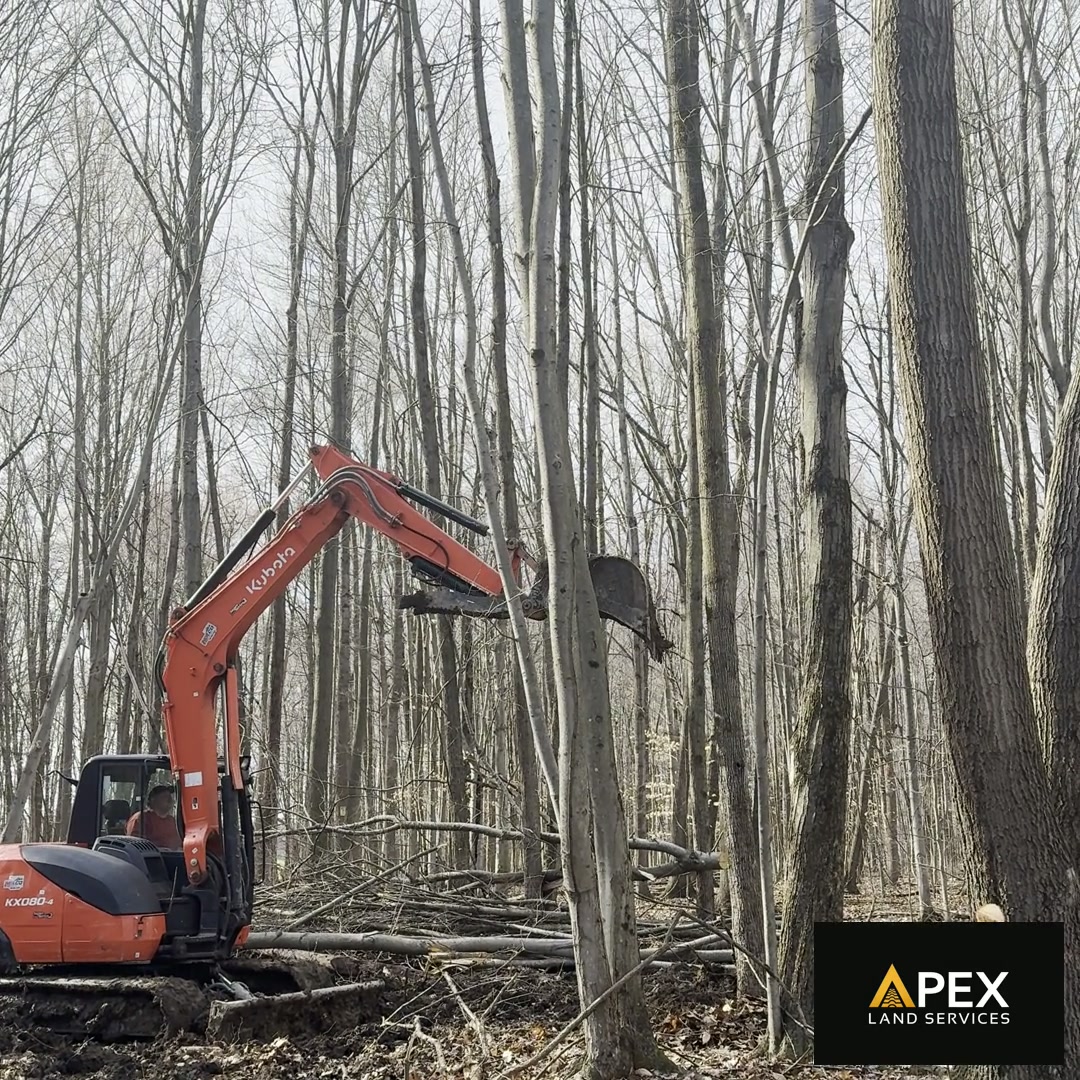
Mature trees over 12 inches, thick canopy, fallen deadwood, and dense understory. This is full woodland clearing and requires the most equipment time. Trees may need to be cut and removed before mulching can begin on the brush layer.
Phase 3: The Work — What Happens on Clearing Day
Equipment Arrives
A compact track loader (CTL) with a forestry mulcher head arrives on a trailer. The machine weighs around 10,000-12,000 pounds and runs on rubber tracks that distribute weight evenly — this protects your ground from deep rutting. Setup takes about 30 minutes.
The Mulching Process
The forestry mulcher is essentially a high-powered drum or disc with carbide teeth spinning at high RPM. It grinds everything in its path — brush, saplings, small trees, stumps — into wood chips in a single pass. The operator works systematically across the clearing area, typically starting from the access point and working outward.
What you'll notice:
- It's loud — hearing protection recommended if you're watching nearby
- Wood chips spray behind and around the machine
- Progress is surprisingly fast on light to moderate brush
- The machine can work on slopes up to about 30 degrees
- Larger trees (12"+ diameter) may need to be cut first, then the stump is ground separately
Stump Grinding
If your project includes stump grinding, this is typically done after the main mulching pass. Stumps are ground 4-6 inches below grade level, and the resulting wood chips fill the hole. Within a season, you won't be able to tell where the stump was.
Phase 4: After — The Transformation
This is the part that surprises most property owners. The change is dramatic and immediate:
Day One
- The cleared area is covered in a uniform layer of fresh wood chips (2-4 inches deep)
- The terrain is fully visible — many owners are surprised by the actual contours of their land
- The property feels significantly larger than expected
- Sight lines open up — you can see fences, property lines, and neighboring features for the first time
- The air smells like fresh-cut wood
Week One
- Wood chips begin settling and turning from green/white to brown
- Any remaining leaf debris dries and blows off
- The scale of the clearing becomes more apparent
- You start planning what to do with the space
Month One
- Mulch layer has compacted slightly
- Early grass and native plants begin sprouting through the mulch
- Ground is firm enough for most follow-up work (grading, construction, fencing)
- The cleared area looks established rather than freshly disturbed
Three to Six Months
- Mulch is actively decomposing and enriching the soil
- Native grasses and plants are establishing naturally
- The area looks like it's been maintained for years
- Soil health is measurably improved compared to pre-clearing
Real Cost Expectations for Northeast Ohio
Pricing depends on three main factors: density of vegetation, acreage, and terrain difficulty.
| Vegetation Level | Cost per Acre | Typical Timeline |
|---|---|---|
| Light brush and overgrowth | $1,500–$2,500 | 1 day per 1-2 acres |
| Moderate brush and saplings | $2,000–$3,500 | 1-2 days per acre |
| Heavy wooded with mature trees | $3,500–$5,500+ | 2-3 days per acre |
| Stump grinding (add-on) | $100–$400 per stump | Same day |
Our minimum service charge is $1,600, which covers mobilization, equipment setup, and clearing for sub-acre projects. This is a flat rate — no surprise add-ons for equipment delivery or setup.
Common Surprises (and How to Avoid Them)
"I Didn't Realize My Property Had So Much Slope"
Dense vegetation hides terrain features. We often discover significant grade changes, drainage swales, or low spots that were invisible under the brush. The site visit helps identify these, but some surprises only emerge during clearing. This doesn't change the cost — it just changes what you can do with the land afterward.
"There's More Junk Under There Than I Expected"
Old fencing, concrete debris, buried tires, abandoned equipment — overgrown properties often hide decades of accumulated junk. Metal objects can damage mulcher teeth, so we scout carefully. If we find significant debris, we'll stop and discuss options before proceeding.
"It Looks So Much Bigger Now"
This is the most common reaction. Properties consistently look 30-50% larger after clearing than owners expected. Dense vegetation compresses your perception of space. Seeing the actual boundaries and terrain for the first time is genuinely surprising.
What Comes Next
After clearing, your property is ready for whatever you have planned:
- Building site prep — grading and foundation work can begin immediately
- Fencing — clear sight lines make fence installation straightforward
- Landscaping — plant directly through the mulch layer
- Pasture establishment — seed grass after raking back mulch in target areas
- Simply enjoying the space — many owners just wanted their view back
Get Started
Ready to see the transformation on your property? The first step is a free estimate — we'll review your property, walk the site if needed, and give you a clear quote with no surprises.
📞 Call (440) 839-8379
🌐 Get an instant estimate at apxlandservices.com/instant-estimate
We serve Lorain, Medina, Huron, Erie, Cuyahoga, Summit, and surrounding counties across Northeast Ohio.