
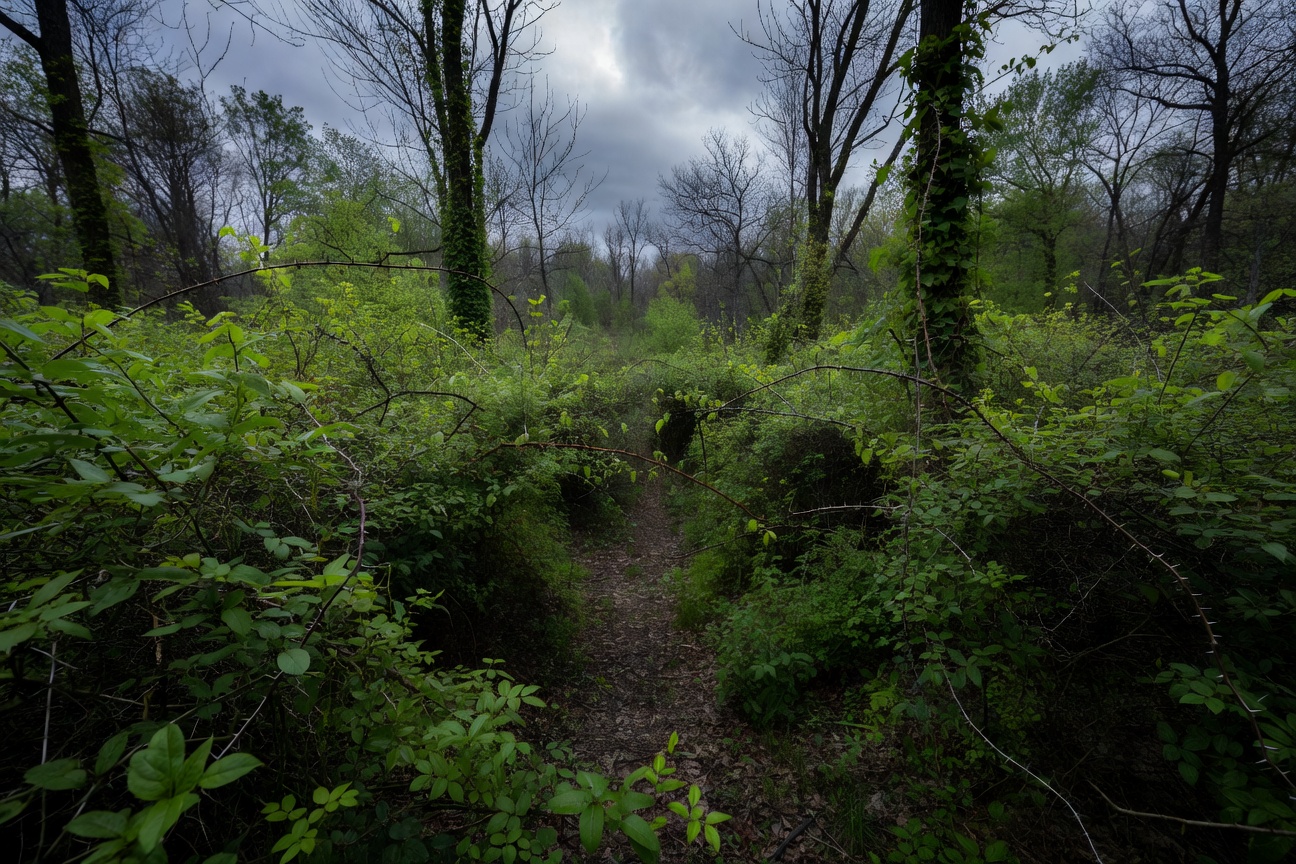
If you own property in Northeast Ohio, you're fighting invasive species whether you know it or not.
These aren't just weeds. They're aggressive, fast-spreading plants that were introduced to North America — sometimes intentionally — and have been taking over Ohio's forests, fields, and backyards ever since. They outcompete native trees and shrubs, destroy wildlife habitat, reduce property values, and turn usable land into impenetrable thickets.
The Ohio Invasive Plants Council tracks dozens of invasive species statewide, but here in the Cleveland-Akron corridor and across Northeast Ohio's rural counties, seven species cause the most damage to private property. Here's how to identify each one, understand why it's a problem, and — most importantly — get rid of it for good.
1. Bush Honeysuckle — The #1 Invasive Plant in Ohio
Not even close. Bush honeysuckle (Lonicera maackii, L. morrowii, L. tatarica) dominates Ohio's invasive species landscape.
How to Identify It
Dense, arching shrubs 6–15 feet tall with opposite leaves. White or yellow tubular flowers in spring, followed by red berries in fall. The dead giveaway: honeysuckle leaves out 2–3 weeks before native plants in spring and holds its leaves 2–3 weeks longer in fall. If it's green when everything else is bare, it's probably honeysuckle.
Why It's a Nightmare
Bush honeysuckle forms dense monocultures that shade out everything beneath them. Native wildflowers, tree seedlings, and ground cover plants can't compete. The berries look like food for birds — and birds do eat them — but they're nutritionally poor compared to native berries, essentially junk food that doesn't sustain wildlife through winter.
Found everywhere in Northeast Ohio: forest edges, fence lines, creek banks, abandoned fields, suburban backyards. Every county. Birds eat the berries and deposit seeds — a single mature bush produces thousands of berries per season. One plant becomes a thicket in 3–5 years.
How to Remove It
- Forestry mulching — The most efficient method for large infestations. A mulcher processes entire honeysuckle thickets in minutes, grinding them into chips. The mulch layer suppresses regrowth.
- Cut-stump herbicide — For scattered plants, cut the stem close to the ground and immediately apply triclopyr or glyphosate to the fresh cut. This kills the root system.
- Pulling — Only works for small seedlings. Mature plants have extensive root systems that break off and resprout.
Best approach: Forestry mulching for the initial clearing, followed by targeted herbicide on any resprouts in the following growing season. One pass is rarely enough — plan for a follow-up check 6–12 months later.
Timing tip: Bush honeysuckle's early leaf-out is actually an advantage. In early spring, it's the only green thing in the woods — making it easy to spot and target while native plants are still dormant.
2. Multiflora Rose — The Thorny Nightmare
How to Identify It
A thorny, arching shrub that forms impenetrable mounds 6–15 feet across. Small white flowers in clusters (May-June), followed by small red rose hips. The thorns curve backward — they hook into skin, clothing, and equipment. Walking through multiflora rose is genuinely painful.
Why It's a Nightmare
It was originally planted by the USDA in the 1930s-50s as a "living fence" and erosion control plant. That turned out to be one of the worst ecological recommendations in American history. A single plant can produce 500,000 seeds per year. It forms thickets so dense that deer won't walk through them.
Extremely common along old fence lines, forest edges, and abandoned pastures in Lorain, Medina, Wayne, and Ashland counties. Stems that touch the ground root and form new plants, and cut stems resprout aggressively from the root crown.
How to Remove It
- Forestry mulching — Excellent for multiflora rose. The mulcher processes thorns, stems, and root crowns in one pass without anyone having to physically handle the thorny material.
- Cut-stump herbicide — Same as honeysuckle. Cut and immediately treat.
- Repeated mowing — 3–4 times per growing season for 2–3 years can exhaust root reserves on flat ground.
Best approach: Forestry mulching eliminates the thorny misery factor. Nobody wants to hand-cut multiflora rose. The mulcher doesn't care about thorns.
3. Autumn Olive — The One the ODNR Accidentally Spread
How to Identify It
A large shrub or small tree, 10–20 feet tall. Silvery-green leaves with distinctive silver scales on the underside — flip the leaf over, and if it's silvery underneath, it's autumn olive. Small, fragrant yellow flowers in spring. Red speckled berries in fall.
Why It's a Nightmare
Originally promoted by the Ohio Department of Natural Resources as wildlife food and erosion control in the 1960s-70s. It fixes nitrogen in the soil, which sounds helpful but actually changes soil chemistry in ways that favor more invasive species over natives. Each plant produces up to 200,000 seeds per year.
Common in abandoned fields, forest edges, and old strip mine reclamation sites across southern Lorain, Medina, Wayne, and Ashland counties.
How to Remove It
- Forestry mulching — Effective for initial clearing. Autumn olive's relatively soft wood mulches easily.
- Cut-stump herbicide — Critical follow-up. Autumn olive resprouts vigorously from cut stumps. If you mulch or cut without herbicide, it comes back stronger.
- Basal bark treatment — For scattered trees, apply triclopyr in oil to the lower 12–18 inches of bark during dormant season.
Best approach: Mulch + immediate herbicide treatment on resprouts. This is one species where mechanical removal alone won't win — you need the chemical follow-up.
4. Tree of Heaven — Never Cut Without Herbicide
How to Identify It
A fast-growing tree reaching 60–80 feet. Compound leaves with 11–25 leaflets that look similar to native sumac or walnut but with a distinctive notch at the base of each leaflet. Crushed leaves and bark smell like rotten peanut butter — once you've smelled it, you'll never forget it.
Why It's a Nightmare
This is the tree that grows through sidewalks, out of storm drains, and between foundation cracks. Each tree produces 300,000+ seeds per year that germinate on virtually any surface. Its root system sends up suckers 50+ feet from the parent tree. Cutting it down actually makes it worse — it responds by producing dozens of root suckers.
More common in urban and suburban areas of Cuyahoga and Summit counties than rural areas.
How to Remove It
- Hack-and-squirt herbicide — The most effective method. Make downward cuts into the bark every 2–3 inches around the trunk and immediately apply concentrated triclopyr or imazapyr into each cut. The tree dies standing and can be removed later.
- Basal bark treatment — For trees under 6 inches diameter, apply herbicide to the lower bark.
- Forestry mulching — Effective for initial clearing but MUST be combined with herbicide. Mulching alone triggers aggressive root suckering.
Best approach: Herbicide treatment first (kill the root system), then remove dead trees via mulching or cutting. Never cut tree of heaven without herbicide — this is the one species where cutting first is a mistake.
5. Japanese Knotweed — The Multi-Year Battle
How to Identify It
Bamboo-like stems 3–10 feet tall with large, flat, heart-shaped leaves. Hollow stems with distinct joints like bamboo. Dies back to the ground each winter, leaving standing dead stems. White flower plumes in late summer.
Why It's a Nightmare
Japanese knotweed has the most aggressive root system of any invasive plant in Ohio. Rhizomes extend 20+ feet laterally and 6–10 feet deep. A root fragment the size of a fingernail can grow a new plant. It grows through asphalt, concrete, foundations, and retaining walls. In the UK, having knotweed on your property can make it unmortgageable.
Common along stream banks and riparian corridors throughout Northeast Ohio, particularly the Cuyahoga River, Rocky River, and Black River watersheds.
How to Remove It
- Herbicide injection — The most effective method. Inject concentrated glyphosate directly into each hollow stem in late summer/early fall when the plant is moving nutrients to its roots.
- Repeated cutting + herbicide — Cut stems monthly through the growing season to exhaust root reserves, with foliar herbicide on resprouts.
- Forestry mulching — Can clear the above-ground growth but does NOT kill the root system. Must be combined with aggressive, multi-year herbicide follow-up.
Best approach: This is a multi-year battle. Initial clearing via mulching + stem injection herbicide + monitoring for 2–3 years. Anyone who tells you knotweed can be eliminated in one treatment is lying.
6. Common Buckthorn — The Bird Laxative Spreader
How to Identify It
A small tree or large shrub, 10–25 feet tall. Dark bark with distinctive small thorns at branch tips. Leaves are oval with finely toothed edges. Dark purple-black berries in clusters in fall. Inner bark is bright yellow-orange — scratch the bark and if it's orange underneath, it's buckthorn.
Why It's a Nightmare
Buckthorn produces massive quantities of berries that birds spread everywhere. It leafs out before native species and drops its leaves after them, giving it a competitive advantage. Its berries contain a compound that acts as a laxative in birds — meaning birds that eat buckthorn berries spread seeds faster and farther than normal.
Increasingly common in forest understory, fence lines, and suburban woodland edges across Cuyahoga, Summit, Lorain, and Medina counties.
How to Remove It
- Forestry mulching — Excellent for dense buckthorn stands. Processes thorny stems and root crowns efficiently.
- Cut-stump herbicide — Standard approach for individual trees. Cut and treat immediately.
- Weed wrench or pulling — Effective for small plants under 2 inches when soil is moist.
Best approach: Mulch + herbicide. Similar to honeysuckle — mechanical removal followed by chemical treatment on resprouts.
7. Callery/Bradford Pear — Banned in Ohio Since 2023
How to Identify It
You probably already know this tree — it was planted in every parking lot, subdivision, and median in America for 30 years. White flowers in early spring with a distinctly unpleasant smell, glossy leaves, and a symmetrical oval shape. The problem: these "ornamental" trees cross-pollinate with each other and produce viable seeds. Those seeds grow into thorny, aggressive wild pear trees completely different from the manicured landscape variety.
Why It's a Nightmare
Wild Callery pear seedlings have 3–4 inch thorns, grow in dense thickets, and are extremely difficult to clear. They're colonizing highway medians, abandoned fields, and forest edges across Ohio at an alarming rate. Ohio officially banned the sale of Callery pear in 2023 — the first state to do so.
Found along highway medians (I-71, I-77, I-90 corridors), abandoned fields, and suburban fence lines.
How to Remove It
- Forestry mulching — Very effective for wild pear thickets. The mulcher handles the thorny growth without anyone getting impaled.
- Cut-stump herbicide — Necessary to prevent regrowth from the stump.
Best approach: Mulch + herbicide. Same playbook as multiflora rose — the thorns make manual removal miserable.
Why Forestry Mulching Is the Best First Strike Against Invasive Species
Notice a pattern? Forestry mulching shows up in the removal strategy for every single species on this list. Here's why it's the most effective initial treatment for invasive plant infestations:
- Speed — A mulcher can clear an acre of dense honeysuckle or multiflora rose in hours. Hand-clearing the same area takes weeks.
- No hauling — Invasive plant material is ground into mulch on-site. No piling, burning, or trucking.
- Mulch suppression — The 2–4 inch layer of wood chip mulch left behind suppresses regrowth and gives native plants a chance to reestablish.
- No contact with thorns — Multiflora rose, wild pear, and buckthorn are brutal to clear by hand. The mulcher doesn't care about thorns.
- Selective capability — A skilled operator can clear invasive species while preserving native oaks, maples, and other desirable trees you want to keep.
The critical follow-up: Forestry mulching handles the above-ground biomass, but most invasive species will attempt to resprout from roots and root fragments. For long-term success, mechanical clearing should be followed by targeted herbicide application on resprouts 4–8 weeks later, and monitoring for 1–2 growing seasons.
When to Act
The worst thing you can do with invasive species is wait. Every year you delay, each honeysuckle bush produces thousands more seeds, each autumn olive colonizes more of your field, and the cost to clear goes up.
Best timing for removal in Northeast Ohio:
- Late winter/early spring (February-April) — Ideal for most species. Ground is firm, invasives are visible (especially honeysuckle's early leaf-out), and native plants are still dormant.
- Late summer/early fall (August-October) — Best for herbicide-dependent species like tree of heaven and knotweed, when plants are moving energy to roots.
- Winter — Frozen ground provides firm footing for equipment. Deciduous invasives are visible as standing dead stems.
Protect Your Property — And Your Neighbors'
Invasive species don't respect property lines. Every plant on your land is producing seeds that spread to your neighbors' properties, nearby parks, and natural areas. Clearing invasives isn't just good property management — it's good citizenship.
If you're dealing with any of the species on this list — or you're not sure what's growing on your property — we're happy to take a look and give you honest advice. Sometimes the answer is "leave it alone." Sometimes it's "we need to get in here before this gets worse."
📞 Call Apex Land Services: (440) 839-8379
🌐 Get a free estimate: apxlandservices.com/instant-estimate
We serve property owners across Northeast Ohio — Lorain, Medina, Erie, Huron, Cuyahoga, Summit, Wayne, Ashland, Richland, Crawford, Ottawa, and Seneca counties.