
You know the lot I'm talking about. Maybe it's a vacant parcel you bought with plans that never materialized. Maybe it's the back half of your property that was passable five years ago and is now a wall of honeysuckle and invasive shrubs. Maybe you inherited land that hasn't seen a mower in a decade.
In Ohio's climate, overgrown properties don't maintain themselves — they accelerate. Brush doubles in density, saplings turn into trees, and invasive species colonize every available inch. The longer you wait, the bigger (and more expensive) the project becomes.
This guide covers everything Ohio property owners need to know about reclaiming an overgrown lot: how to assess what you're dealing with, which clearing method fits your situation, what it costs in Northeast Ohio, and when to call a professional versus handle it yourself.
Signs Your Lot Needs Professional Clearing
Not every overgrown property needs a crew. But there's a threshold where professional clearing saves time, money, and physical wear. Here are the signs you've crossed it:
Trees over 4 inches in diameter
A single chainsaw and determination can handle small saplings. But trees over 4 inches in diameter require proper technique, personal protective equipment, and experience to fell safely. This is especially true in Ohio, where dead ash trees from the emerald ash borer — heavy, brittle, unpredictable — are everywhere. Don't underestimate a standing dead ash.
Dense invasive species coverage
Bush honeysuckle, multiflora rose, and autumn olive regrow aggressively after cutting. If 30% or more of your lot is covered in these species, manual clearing without follow-up herbicide treatment is a losing battle. Professional crews can mulch and apply targeted herbicide in the same visit.
Area over a quarter acre
Clearing a quarter acre by hand is a weekend project. Clearing a half acre is a month. Clearing an acre or more is a project that never ends. When the area exceeds a quarter acre of moderate-to-heavy growth, professional equipment is faster and often cheaper once you factor in equipment rental, fuel, and your own labor cost.
Safety hazards in the vegetation
Dead trees, hanging limbs, hidden holes, and collapsing structures are common in neglected properties. These are hazards that you can't always identify until you're in the middle of them. Professional operators know how to work around these risks.
You have a timeline (building, selling, or improving the property)
If you're preparing to build, need a cleared lot for an appraisal, or want the property usable by a specific date, professional clearing gets you there in days instead of months.
Clearing Methods Compared: Forestry Mulching vs. Bulldozing vs. Manual
The clearing method you choose affects cost, timeline, soil condition, and what the property looks like afterward. Here's an honest comparison:
Forestry Mulching
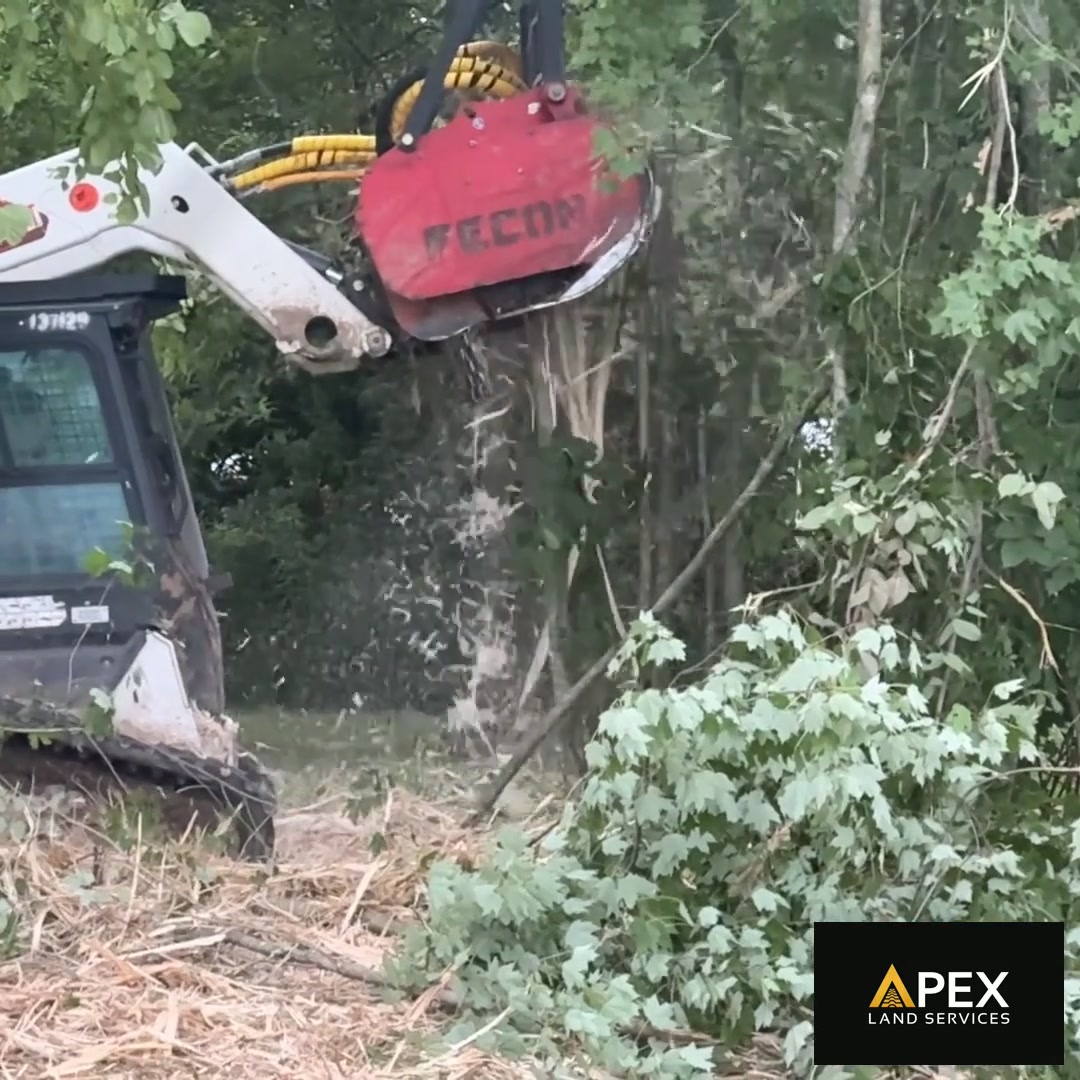
A compact track loader with a mulching head shreds trees, brush, and stumps in a single pass. Chips are left on the ground as natural mulch. No burning, no hauling, no secondary cleanup phase.
- Best for: Overgrown residential lots, brush-heavy parcels, land with invasive species, properties where soil preservation matters
- Handles: Trees up to 6–8 inches in diameter, dense brush, stumps to below grade
- Pros: Fastest method, lowest cost for most situations, protects topsoil, preserves soil structure
- Cons: Not ideal for very large trees (10+ inches), not a substitute for complete stump extraction if you're pouring concrete
Excavation / Bulldozing
A bulldozer pushes everything — trees, roots, topsoil, and all — into piles or windrows that are then burned or hauled away.
- Best for: Full site preparation where grading is also required, very dense heavy timber, properties where complete topsoil disturbance is acceptable
- Pros: Handles very large trees, also grades the site
- Cons: Destroys topsoil and soil structure, costly to haul debris, may require burn permits, creates erosion risk, slower for brush-only clearing
Manual / Hand Clearing
Chainsaws, brush cutters, and hand tools with debris burned or chipped on-site.
- Best for: Small areas under a quarter acre, selective clearing of individual trees, tight access situations where equipment can't reach
- Pros: Low equipment cost, precise selection of what stays and what goes
- Cons: Labor-intensive, slow, invasive species regrow quickly, stump management becomes a separate problem
What Does Overgrown Lot Clearing Cost in Ohio?
For Northeast Ohio properties, here are realistic cost ranges:
| Vegetation Type | Cost Per Acre (Forestry Mulching) |
|---|---|
| Light brush and saplings under 2" | $1,000–$2,000 |
| Medium brush, saplings 2–5" | $2,000–$3,500 |
| Heavy brush, trees up to 8" | $3,000–$5,500 |
| Stump grinding (per stump) | $100–$400 |
| Complete stump removal | $250–$800+ |
Real examples from NE Ohio
Half-acre overgrown backyard in Medina County — Light brush, honeysuckle, and small saplings. Typical cost: $800–$1,500.
One-acre neglected lot in Lorain County — Mixed brush, invasive species, trees up to 5 inches, 8 stumps. Typical cost: $3,000–$4,500.
Two-acre overgrown field in Huron County — Dense brush and agricultural succession saplings, flat terrain. Typical cost: $4,000–$7,000 depending on density.
Factors that move the price up or down
- Mobilization distance — Properties close to our base in Wakeman cost less to mobilize
- Terrain — Steep slopes, wet areas, and restricted access take more time
- Tree size — Trees over 6 inches add cost per tree
- Stump count — High stump counts after clearing add to total
- Season — Winter (frozen ground) and early spring often offer better scheduling and pricing
How Long Does Lot Clearing Take?
With professional forestry mulching equipment:
- Quarter acre of light-to-medium brush: 3–5 hours
- Half acre, mixed brush and saplings: 5–8 hours (same day)
- One acre, moderate density: 1 full day
- Two acres, moderate density: 1.5–2 days
- Three-plus acres: 2–4 days depending on density and terrain
These are clearing-only estimates. If large trees need to be felled first, or if complete stump extraction is needed for a building foundation, add time accordingly.
The Best Time to Clear in Ohio
Ohio's seasonal patterns matter for overgrown lot clearing, especially if your lot has clay-heavy soils (common in Lorain, Medina, Huron, and Erie counties).
Late February through mid-April (Recommended)
This is the best clearing window in NE Ohio. Ground is firm enough for equipment, vegetation is dormant (easier to see and work with), and invasive species haven't leafed out yet. Once spring rains start in late April, clay soils can become too soft for heavy equipment.
September through November
The second-best window. Summer heat has subsided, ground conditions are stable, and you're setting up the property for a clean start the following spring. Invasive species are identifiable by their late-season foliage.
Winter (December through February)
Frozen ground is excellent for heavy equipment. No leaf cover means full visibility into the lot. This is an underutilized clearing window in Ohio.
Summer
Possible but not ideal. Vegetation is at peak density (slower work), ground can be soft after rains, and scheduling is tighter during peak season. If summer is your only option, it can still get done — just expect longer timelines and possible scheduling delays.
When to Call a Professional
Call a professional lot clearing company when:
- The lot is over a quarter to half acre of moderate growth
- Trees over 4 inches are present (especially dead or damaged trees)
- You have significant invasive species coverage
- You're on a deadline — building, selling, or improving
- You've tried DIY and aren't making progress
- Safety is a concern (dead trees, unknown hazards in heavy growth)
What to expect from a professional estimate
A reputable contractor will visit your property (not just quote over the phone), assess vegetation density and type, discuss what you want to preserve and what you want cleared, and give you a written estimate. The estimate should break out clearing from stump work. Be wary of contractors who quote without seeing the property.
Ready to Reclaim Your Overgrown Lot?
Apex Land Services clears overgrown properties across Northeast Ohio — from quarter-acre backyards to multi-acre rural parcels. We use professional forestry mulching equipment that gets the job done in one pass without burning, hauling, or destroying your topsoil.
We're based in Wakeman and serve Lorain, Medina, Huron, Erie, Cuyahoga, Summit, and surrounding counties. Free on-site estimates, same-day response.
📞 Call (440) 839-8379
🌐 Get an instant estimate at apxlandservices.com/instant-estimate