Excavation in Erie, Huron, and Lorain counties is usually not a single-task job. A property owner may ask for a driveway, culvert, building pad, pond, trench, or drainage fix, but the real scope often starts with access, clearing, soil, water, and where the site needs to end up when the machine work is done.
That is why Apex Land Services looks at excavation as practical site work, not just dirt moving. The goal is to make the property usable: get equipment in, get water moving the right direction, prepare the next phase, and avoid doing cheap work that has to be fixed after the first heavy rain.
Why These Three Counties Need Their Own Excavation Plan
Erie, Huron, and Lorain counties sit close together, but the sites can be very different. Erie County adds lake-influenced drainage and flat ground near Sandusky, Huron, Vermilion, Milan, and Berlin Heights. Huron County has rural farm lanes, wooded building sites, low clay ground, and home-market projects around Wakeman, Norwalk, New London, Willard, Greenwich, and Monroeville. Lorain County mixes suburban growth near Elyria, Avon, Amherst, North Ridgeville, and Lorain with rural acreage around Wellington, Oberlin, Grafton, LaGrange, and Rochester.
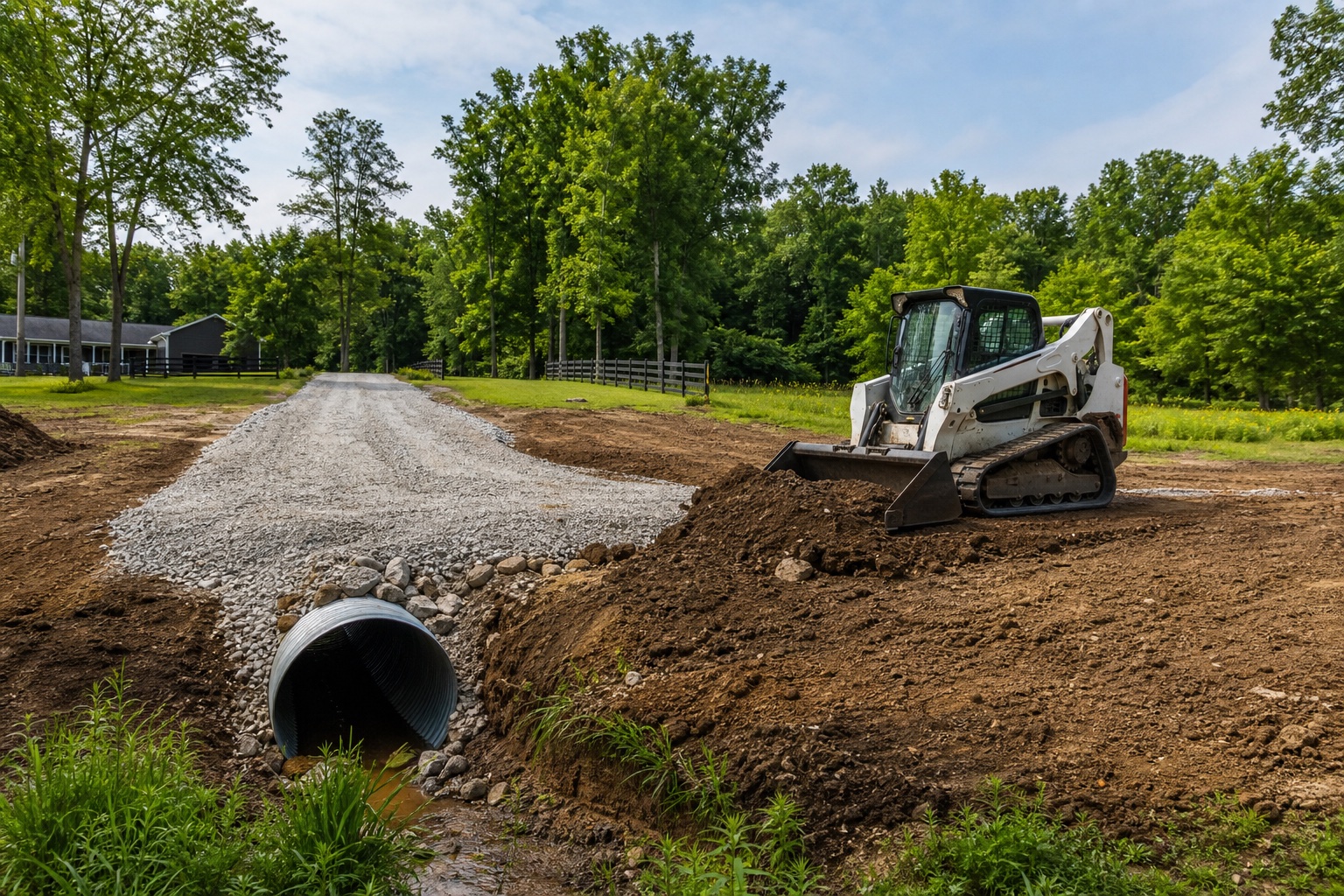
Those differences matter. A driveway installation in Erie County may need water managed carefully around flat grade and lake-area runoff. A Huron County farm lane may need culvert work and a stone base that can hold up during wet seasons. A Lorain County building site may need clearing, stump work, drainage planning, and truck access before a builder can use it.
Common Excavation Projects We See Locally
| Project type | Common counties | What has to be planned |
|---|---|---|
| Driveway installation and access | Erie, Huron, Lorain | Route, clearing, ditch crossings, culverts, stone base, drainage, and truck access |
| Culvert installation | Huron and Lorain rural drives, Erie drainage crossings | Pipe size, ditch flow, cover depth, stone, headwalls, and approach grade |
| Building site prep | All three counties | Clearing, stumps, pad location, rough grade, drainage, and material access |
| Site grading and drainage | Flat Erie sites, clay-heavy Huron and Lorain properties | Water source, discharge path, slope, outlet, and long-term maintenance |
| Pond digging and expansion | Rural Huron, Lorain, and Erie acreage | Access, depth, water conditions, spoil placement, and surrounding grade |
| Utility trenching | Homes, barns, outbuildings, and rural improvements | Route, depth, obstacles, backfill, and restoration |
Driveway and Access Work Comes First
A lot of excavation projects fail before they start because the site does not have usable access. If stone trucks, concrete trucks, delivery trailers, equipment, or emergency vehicles cannot reach the work area, the main project becomes slower and more expensive.
For wooded or overgrown properties, driveway work may start with driveway and access clearing, land clearing, and forestry mulching. Once the route is open, it is easier to see drainage, grade, stumps, soft ground, and where a culvert or stone base may be needed.
Drainage Should Not Be an Afterthought
Water is the part of excavation that punishes shortcuts. A driveway can look good on a dry day and still wash out, rut, or hold water if runoff is not planned. A building pad can look level and still create problems if water has nowhere to go.
Before the digging starts, ask three questions: where does water come from, where does it sit, and where can it leave without creating a new problem? The answer may point toward culvert installation, site grading and drainage correction, French drains, drain tile, or a simpler grading change.
County-by-County Excavation Notes
Erie County Excavation
Erie County excavation often revolves around water, access, and flat ground. Around Sandusky, Huron, Vermilion, Milan, Berlin Heights, and the inland farm areas, small grade changes can matter because water does not always leave quickly on its own.
For Erie County, the strongest excavation scopes usually connect driveway access, culverts, site grading, drainage, and clearing into one plan. See Erie County excavation services, Erie County culvert installation, and Erie County drainage services.
Huron County Excavation
Huron County is Apex home territory from Wakeman. That matters for excavation because site walks, small mobilizations, and follow-up work are practical. Common Huron County projects include farm lane repair, rural driveway access, culverts, drainage fixes, pond work, pole barn site prep, and clearing before construction.
Huron County clay and farm ground can change quickly with weather, so timing and access matter. For local projects, see Huron County excavation services, Huron County culvert installation, and Huron County land clearing.
Lorain County Excavation
Lorain County has two different excavation markets in one county. The east and lake-adjacent communities bring tighter residential access, drainage, and finish expectations. Southern and western Lorain County bring rural drives, wooded parcels, farm lanes, outbuildings, and acreage projects.
That mix makes planning important. A Lorain County excavation contractor needs to think through access, clearing, ditch crossings, municipal or township constraints, and how water moves across clay-heavy ground. For local pages, see Lorain County excavation services, Lorain County driveway and access clearing, and Lorain County culvert installation.
When Clearing and Excavation Should Be Quoted Together
If the job site is wooded, brushy, stump-heavy, wet, or hard to reach, separating clearing from excavation can create bad estimates. The excavation contractor may not know what is under the brush. The clearing crew may not know the driveway, pad, or drainage plan. The property owner ends up coordinating two scopes that should have been planned together.
Apex is built for that overlap. We can clear the access route, mulch brush, handle stump work where needed, open the site, and then move into the dirt work with a clearer understanding of grade, drainage, and future use.
What Changes Excavation Cost
- Distance from the road to the work area
- Whether trees, brush, or stumps need cleared first
- Soil moisture, clay, slope, and stability
- Culverts, stone, fabric, drain pipe, or other materials
- Whether spoils can stay on site or need shaped and moved
- How finished the grade needs to be
- Whether the route must support construction traffic, daily vehicle use, farm equipment, or light access only
The cheapest excavation quote is not always the cheapest finished project. If drainage is ignored, the driveway base is thin, the culvert is undersized, or stumps are left where future grade needs to go, the repair can cost more than doing the scope correctly the first time.
How to Get a Better Excavation Estimate
- Send photos from the road, entrance, ditch, and work area
- Mark the route or work zone on a parcel screenshot
- Explain the end use: driveway, pole barn, home site, pond, drainage fix, trench, or farm access
- Mention wet spots, ditches, utilities, septic areas, fences, slopes, and soft ground
- Say whether trucks and construction deliveries need to use the route
- Share whether cleared material and excavated soil can stay on site
That information helps separate a simple access job from a full driveway, drainage, or site-prep scope. It also helps decide whether the first step should be clearing, culvert work, stone, grading, drainage, or all of the above.
Get an Excavation Estimate in Erie, Huron, or Lorain County
If you are planning driveway installation, culvert work, drainage correction, rough grading, pond digging, trenching, or building site prep in Erie, Huron, or Lorain County, start with the site details. Apex Land Services can look at access, clearing, water, soil, and excavation together so the quote matches the real property.
Call (440) 839-8379 or use the instant estimate form. Include the county, nearest town, photos, what you want done, and anything you already know about wet areas, ditches, access, or future construction.